
The potential for green hydrogen production in Ukraine is 505 million cubic meters
What is needed for the development of this direction? Ukraine, which is moving towards integration with the European Union, is increasing the presence of its goods and services in international markets, recognizing the importance of implementing a green economy and reducing carbon emissions in production.

Despite the war and the scale of destruction caused by the Russian aggressor, our country is committed to not stopping the decarbonization process. This will help reduce harmful gas emissions and improve the environmental situation in the country.
One of the key tools in the decarbonization process is the use of hydrogen.
Hydrogen has the potential to become the primary source of energy for Ukraine's economy. It can be used in various sectors, including transportation, industry, and energy. The use of hydrogen will help reduce dependence on imported oil and gas, which will have a positive impact on the country's economy.

However, successful implementation of hydrogen in the economy requires significant investment and technological progress. It is necessary to develop infrastructure for hydrogen production, storage, and transportation, as well as conduct research in this field.
Out of nearly 200 countries worldwide, 96 have programs and strategies for industrial-scale hydrogen production. France and Germany are the leaders in this regard. It seems that the world is seriously gearing up for hydrogen.
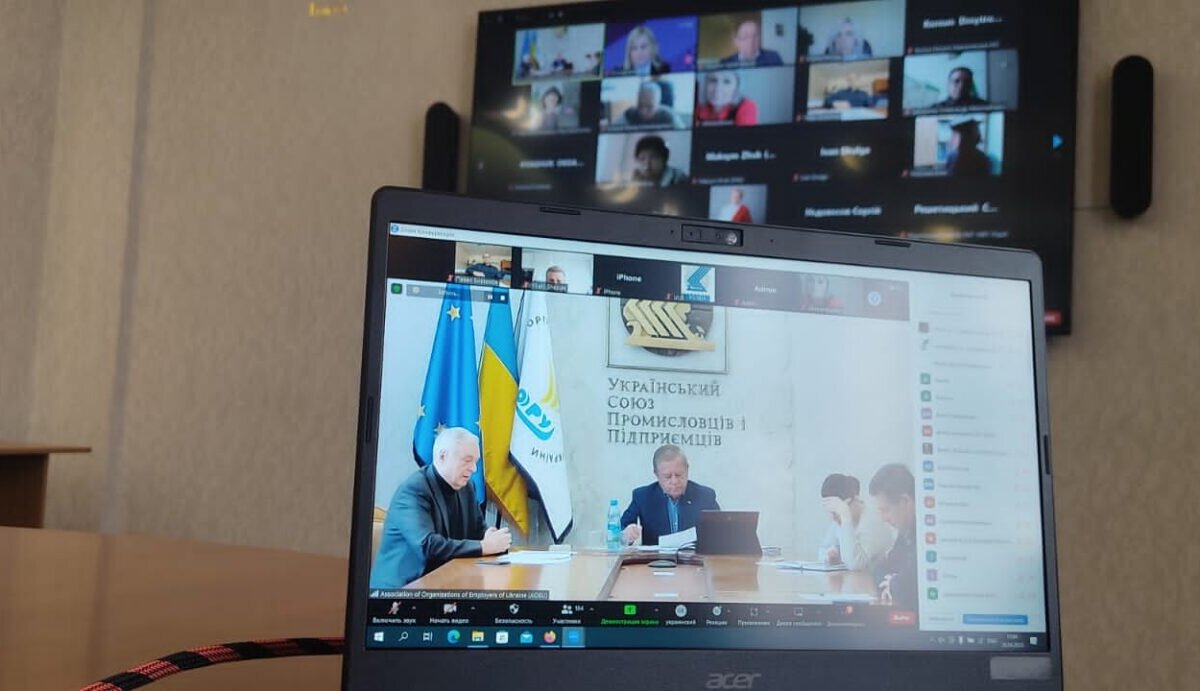
This was discussed during a webinar organized by the Association of Employers of Ukraine and the International Labor Organization. The event was part of the project "Business Resilience During War," implemented by partners.

The Chairman of the Association of Employers of Ukraine, Anatoliy Kinakh, the Director for Employers' Activities of the ILO Bureau for Central and Eastern Europe, Julia Druhnia, and the Director of the Department of Renewable Energy Development at the State Agency for Energy Efficiency and Energy Saving, Olena Lenska, delivered welcome speeches.

Anatoliy Kinakh noted that the long-term plans for hydrogen energy development in Ukraine are very optimistic. There are projected surplus capacities in the world for solar and wind energy, which are getting cheaper year by year. The surplus energy is converted to hydrogen through electrolysis, which will be stored and used as needed.
The challenge lies in the requirement of separate infrastructure for hydrogen. Therefore, it is predicted that the development of this direction in Ukraine will only begin after 2030.
According to preliminary calculations, Ukraine can produce 500 million cubic meters of hydrogen per year. In the future, with favorable state policies and both external and internal investments, this figure could reach 5 billion cubic meters in approximately 20-25 years.
Since Ukraine is only at the beginning of this path, while countries like France have actively integrated hydrogen, even in their exports, French representatives were invited to participate in the webinar.
Mikaa Mered, a lecturer on hydrogen markets, diplomacy, and geopolitics at Sciences Po Research University (France), spoke about the evolution of the hydrogen industry in her country.
The national demand for hydrogen in France in 2021 was 860,000 tons. The main national target for green hydrogen by 2030 is 475,000 tons per year. There are two scenarios for further development: the "Ambition2030" scenario, aiming for 675,000 tons per year, and the "Ambition2030+" scenario, aiming for 1,090,000 tons per year.
All regional authorities have their own H2 strategies, with a total funding of €600 million for value chain projects throughout the country.

Nicolas Rega, Executive Director of Climate Change and Energy at the European Chemical Industry Council (CEFIC), outlined how the use of hydrogen enhances the competitiveness of the European industry, using the chemical industry as an example.
According to him, in the near or medium-term, it will be challenging to replace natural gas as an energy source or feedstock in the chemical industry.
However, the chemical industry already produces hydrogen for its own consumption, at around 4 million tons per year.
It is primarily used as a feedstock, and that is the priority direction for hydrogen utilization.
Both renewable and low-carbon hydrogen will play a role in the industry's path towards carbon neutrality.
This will help preserve industrial sites and employment during the transition to climate-neutral production.
"Hydrogen, renewable gases, and low-carbon gases should be supplied through dedicated pipelines. The transmission system operator should be responsible for delivering such gases of stable and predictable quality to the chemical industry. Access to renewable hydrogen and low-carbon gases should be economically competitive," explained Nicolas Rega.
The presentations of webinar speakers Myroslav Tabakhniuk and Yuriy Bondarenko attracted participants' interest. It was noted that Ukraine needs its own electrolyzer production, experiments were conducted at the Trypillya TPP on adding hydrogen to fuel in boilers, and a project for industrial hydrogen production at the DniproHES with a 1 MW electrolyzer was developed but cannot be implemented due to the state of war.
Myroslav Tabakhniuk, Chairman of the Decarbonization Center of the Ukrainian Association of Employers' Organizations, stated that preliminary research indicates that the share of hydrogen in natural gas produced in Ukraine is insignificant (up to 5%), and its separation requires more resources than synthesis.
As for the strategy, the market will determine everything. Ukraine is certainly interested in a new energy source but also requires funds for equipment modernization, so it could export for profit.
"The key advantages here are the presence of the Ukrainian GTS, which can be redirected from gas transportation to hydrogen transportation (separate calculations are needed), and Ukrainian science. Currently, it is actively engaged in researching hydrogen production from biomass and other sources," informed Myroslav Tabakhniuk.
He presented the prospects for hydrogen energy development in Ukraine.
To achieve this, new pipeline networks, storage technologies, and research and development for cost-effective hydrogen production are needed.
"At this stage, Ukraine's priorities are the development and approval of a national hydrogen strategy and the creation of the necessary regulatory framework. Finding funding, modernizing the Ukrainian GTS for hydrogen transportation, and initiating the use of municipal transport powered by hydrogen are necessary. We also propose developing projects to modernize coal-fired power plants to use hydrogen fuel," noted the speaker.
Yuriy Bondarenko, Vice President and Chair of the Technical Committee of the International Council on Large Electric Systems (CIGRE) in Ukraine, discussed the prospects of implementing green hydrogen in energy facilities in Ukraine.
"The use of hydrogen in thermal power engineering has its advantages and disadvantages. Although hydrogen-based technologies can become an important component of future clean energy systems, we need to consider all aspects of its integration into the thermal block's design," he explained.
According to research by Ukrainian Academy of Sciences scholars (Karp, I.), the effective and safe operation of the Unified Energy System of Ukraine requires flexible capacities for regulating daily and seasonal loads, as well as an increase in the share of renewable energy sources (RES) in the power system. Hydrogen is considered one of the primary energy sources for flexible capacities. "Green" hydrogen, which can be centrally produced or generated on-site using electricity from renewable sources or nuclear power plants, is the priority. The National Energy Company "Ukrenergo," which manages the Unified Energy System of Ukraine, estimates the need for flexible capacities at 2.5 GW. Technologically, these capacities should be based on the use of gas internal combustion engines, which have sufficiently high efficiency and can be connected to the power system within minutes. To ensure such capacity throughout the year (assumed to be 8,000 hours) using hydrogen (with an efficiency of 40%), it would require 16.8 billion cubic meters.

Юрій Бондаренко переконаний, що першочергово потрібна програма декарбонізації українських теплових електростанцій з впровадженням новітніх технологій, в тому числі водню.
Стартом можуть стати пілотні проекти для оцінки модернізації конкретних блоків, наприклад Трипільської ТЕС, Київської ТЕЦ-6, ТЕЦ-5.
При цьому потрібно освоїти виробництво електролізерів в Україні за підтримки світових виробників та розглянути використання когенераційних установок різної потужності на теплових електростанціях.
Свої доповнення до даної тематики надав і Сергій Кучер, заступник директора департаменту з управління персоналом та соціальними питаннями ПрАТ «Укргідроенерго».
«Укргідроенерго» − найбільша гідрогенеруюча компанія в Україні, провідний виробник електроенергії з відновлювальних джерел державного сектору економіки, який забезпечує покриття пікових навантажень, регулювання частоти та потужності мережі, мобільний аварійний резерв у об’єднаній енергетичній системі України.
До складу компанії входять десять станцій на річках Дніпро та Дністер: Київська ГЕС та Київська ГАЕС, Канівська ГЕС, Кременчуцька ГЕС, Середньодніпровська ГЕС, Дніпровська ГЕС-1 та Дніпровська ГЕС-2, Каховська ГЕС, Дністровська ГЕС та Дністровська ГАЕС. Канівська ГАЕС та Каховська ГЕС-2 в процесі підготовки до будівництва.
УГЕ має можливість виробляти саме «зелений» водень, який є найперспективнішим.
Тут опікуються пілотним водневим проєктом. За рік електролізер може виробити 164,2 тис. кг водню або 1,8 млн. м3.

Насамкінець про роль держави в стимулюванні виробництва зеленого водню в Україні розповіла директор з розвитку бізнесу Компанія SPP DevelopmentUkraine Надія Петрученко.
Державну підтримку можна поділити на 2 напрями: спрощення регулювання та фіскальні стимули.
Україна працює в напрямку розробки комплексної нормативно-правової бази щодо розвитку водневої енергетики. Також передбачені фіскальні та інвестиційні стимули.
Учасники заходу дійшли згоди, що розвиток водневої енергетики є необхідним елементом післявоєнного відновлення країни, що має відбуватися із врахуванням принципів «зеленої» економіки.
Проте більшість доповідачів акцентували увагу, що в Україні немає створеної транспортної інфраструктури під водень, виробництва електролізерів. Тому першочергові кроки держави, бізнесу, інвесторів повинні бути саме в цьому напрямі.