
The SURE program is providing training for small and medium-sized business owners
The program is being conducted in collaboration with the International Labour Organization (ILO) and the Association of Employers of Ukraine (AOEU). Its goal is to offer consulting services to companies on business continuity and resilience during times of war.
Серія тренінгів забезпечить компанії знаннями та навичками, які дозволять їм приймати обrрунтовані рішення, пов’язані з оцінкою ризиків та плануванням на випадок надзвичайних ситуацій. Очікується, що по завершенню тренінгів компанії зможуть розробити стратегії розвитку бізнесу, адаптовані до їхніх потреб.
The training series will equip companies with knowledge and skills to make informed decisions related to risk assessment and emergency planning. It is expected that upon completion of the training, companies will be able to develop business strategies tailored to their needs.
Four training streams are planned, each involving 10 business owners or managers who have between 5 and 50 employees in their companies. The first stream, led by Svitlana Nasirova, started on April 10th. Svitlana Nasirova, an expert with 15 years of management experience, 7 years of facilitation and strategic session experience, and over 100 consultations for SMEs in the past 2 years, is the trainer for this stream.
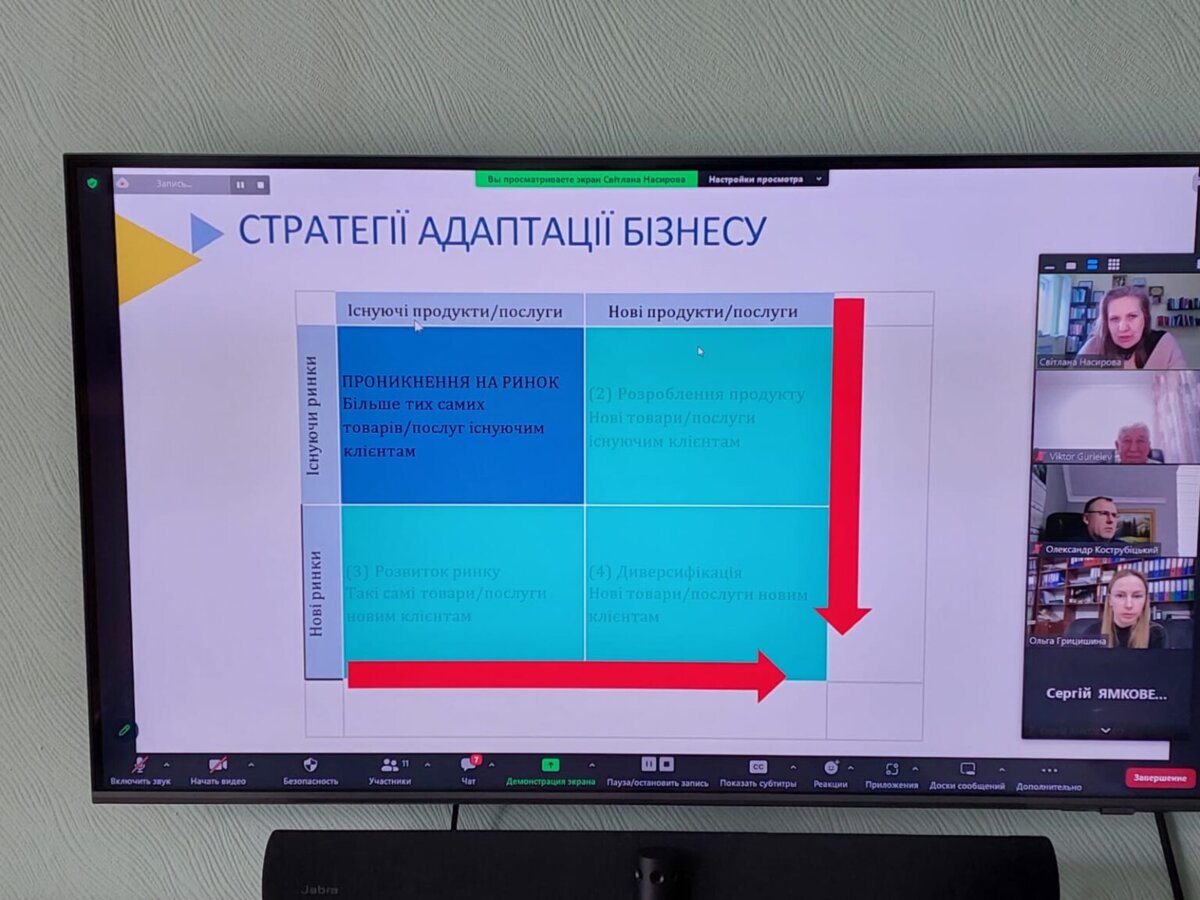
Each training stream consists of five online modules, each lasting four hours. According to Svitlana Nasirova, the sessions will be highly interactive. Participants will work in mini-groups, discuss their real-life cases, receive feedback from the trainer and their fellow participants.

They will also conduct research and evaluate the key components of their businesses and develop business strategies, including for new prospective areas of entrepreneurial activity.
During the introduction, participants shared information about their companies, how they make strategic decisions, and the challenges they face.
Among the participants are businesses in consulting, machinery manufacturing, software development, distribution of Austrian technologies for utilities, specialized equipment manufacturers, and healthy food producers, among others.
Some have been able to adapt to the challenges of wartime and make their operations more flexible, sometimes by shifting to completely new areas. Others are in a state of downtime and are striving to make decisions that will either keep the company afloat or start a completely new line of business.
The problems they face vary from a decline in order volumes and intense competition in narrow market niches to loss of staff who have migrated abroad. Based on the geographical distribution of the first stream, participants mainly came from regions affected by the war as well as central regions of Ukraine, including Kyiv, Kharkiv, Dnipro, and Vinnytsia.
What unites the participants is the almost complete absence of strategic planning. Some company owners mentioned that decision-making in terms of business development is intuitive. Others have integrated some elements of planning, such as strategic sessions and discussions.
However, given the challenges associated with the war, it is critically important not only to react to existing problems, such as tariff increases and declining orders, but also to anticipate risks well in advance and take measures to avoid or minimize them.
During the introduction, Svitlana Nasirova recommended that the owner of a software development company consider strengthening their team in the field of promotion.
She also suggested that the owner of a company from Vinnytsia, which is currently experiencing downtime, develop a business strategy for one of the new directions they are considering. This is because the existing market for their products, according to the participant, has significantly narrowed, and there is a decline in demand for the production of containers and other storage solutions.
In addition to risk analysis and management, the other modules will cover networks and partnerships for business, the role of leadership, and building a corporate culture, among other topics.
Throughout the training, participants will have the opportunity to ask specific questions to the trainer about business management and development, as well as receive guidance on writing business strategies.
They will also have the chance to interact with each other through a private Telegram channel for participants (the link has been sent to everyone's registered email address and will also be available in the recorded videos).
It is worth mentioning that the training for Ukrainian entrepreneurs is free of charge thanks to the support of the AOEU partner, the International Labour Organization.
The other training streams will begin on May 1st, May 22nd, and June 5th, respectively.